Everything You Need to Know About Water Birth and How to Prepare

Supporting Your Body After Birth: Recovery Tips for the Fourth Trimester
June 19, 2026
Understanding the Important Factors in an Unmedicated Birth
July 23, 2026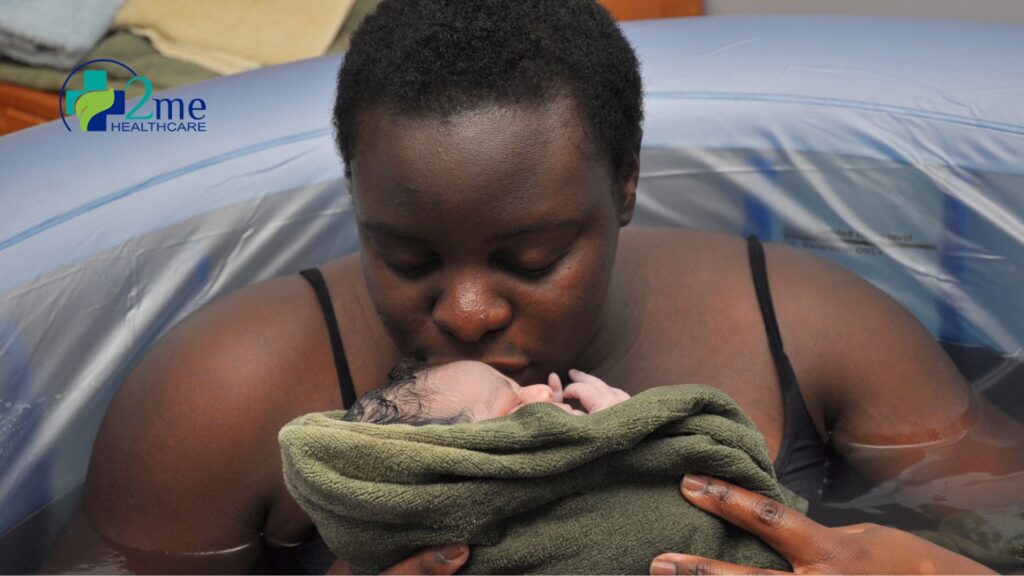
Water birth is one of the most searched and least understood options in modern maternity care. Many expecting parents come across the term while researching low-intervention births, and the images that follow are often compelling, with soft lighting, a calm tub, and a mother moving freely through contractions.
That image is not far from reality, but there is more to know before it becomes your plan. The benefits are real, the risks are manageable with the right provider, and the preparation starts well before your due date.
What Is a Water Birth?
Before diving into preparation, it helps to clarify the term. A water birth can refer to two different experiences. The first is laboring in water, which means spending part of active labor in a warm, deep tub for pain relief and relaxation. The second is delivering in water, which means the baby is actually born while you are submerged.
Many women choose to do one but not the other. Both are legitimate choices, and both require a qualified, experienced provider present throughout. Understanding which option you are considering will shape every other decision you make.
The Benefits of Water Birth
Natural Pain Relief During Labor
One of the most well-documented benefits of laboring in water is its effect on pain perception. Warm water reduces the gravitational load on your pelvis and lower back. The buoyancy allows your body to shift positions more freely, which takes pressure off the sacrum and hips during contractions.
In addition, warm water promotes the release of endorphins and lowers cortisol. Many women who labor in water report a significantly reduced need for epidurals or other medication. For those pursuing a low-intervention birth, this alone makes water birth worth exploring.
Support for Labor Progression
Beyond comfort, relaxation plays a functional role in labor. When the body is tense, the muscles surrounding the cervix can resist dilation. As tension decreases in warm water, contractions often become more effective.
Furthermore, the freedom of movement in a tub allows you to find positions that work with your baby’s descent, rather than against it. Labor in water does not guarantee a faster birth, but the conditions it creates are generally favorable for progression. Some research even suggests that water births are associated with lower rates of perineal tearing, though individual outcomes vary.
A Gentler Transition for Your Baby
For the baby, being born into warm water closely mirrors the environment of the amniotic sac. The transition from womb to world is gradual rather than abrupt. Delayed cord clamping remains fully possible in a water birth setting.
Who Is a Good Candidate for Water Birth?
Water birth is best suited for low-risk pregnancies that have reached at least 37 weeks of gestation. Ideal candidates are carrying a single baby in a head-down position, with no signs of infection, meconium in the amniotic fluid, or fetal distress.
Conversely, women managing preeclampsia, gestational diabetes, or certain placental conditions are generally not candidates. Because candidacy depends so much on individual history, this is exactly the kind of conversation that benefits from a dedicated provider who knows your full picture.
Understanding the Risks
No birth option is without considerations. The most frequently cited concern with water birth is the rare risk of water aspiration if a baby experiences distress at the moment of delivery. Infection is another factor, which is why proper tub sanitation protocols are non-negotiable.
Water temperature must also be carefully monitored. The tub should stay at or close to body temperature, between 98 and 100 degrees Fahrenheit, to avoid overheating. The American College of Obstetricians and Gynecologists acknowledges that laboring in water is reasonable for low-risk women, while noting that evidence on actual underwater delivery continues to evolve.
How to Prepare for a Water Birth
Ask Early and Be Specific
Start by confirming whether your preferred facility has a tub, and ask directly about their policies. Find out what triggers a transfer out of the water, and make sure you are comfortable with those protocols. Knowing the answers before labor begins removes unnecessary decision-making in the moment.
Build Your Preferences Into Your Birth Plan
Write your water birth preferences clearly, and always include contingency options. If the tub is occupied or unavailable when you arrive, your provider needs to know your next preference. A thorough birth plan is not about controlling the outcome. Rather, it is about ensuring your voice is present even when you are focused on the work of labor.
Prepare Your Body and Your Mind
During the third trimester, practice spending time in a warm bath. Use this time to rehearse breathing techniques and get comfortable with the sensation of moving through contractions in water. Relaxation in water is a skill, and like any skill, it benefits from practice before the moment you need it most.
Pack Thoughtfully
For the tub, you will want minimal, comfortable swimwear or nothing at all. Bring a hair tie, lip balm, and a cold cloth for your forehead. Your support person should be prepared to get wet and should know their role during water labor in advance.
Making the Right Choice With the Right Provider
Ultimately, a water birth can be a safe, deeply satisfying option for the right candidate with the right support. The preparation matters as much as the birth itself. At OB2Me, we bring concierge obstetric care directly to you, which means your birth preferences are discussed in depth from the very beginning, not handed off to whoever is on call. If you are exploring all of your options, contact OB2Me to begin that conversation. You deserve to feel prepared, supported, and genuinely heard when the moment arrives.

Carson Ragan, CNM is a Certified Nurse Midwife with more than 25 years of experience in Labor & Delivery, Neonatal ICU, and women’s healthcare. After becoming a mother at a young age and experiencing the birth of her premature second child, she was inspired to pursue nursing and ultimately midwifery.
She earned her nursing degree from Columbus State University and graduated as an RN in 1999. After years of experience as an L&D and NICU nurse, charge nurse, educator, and clinician, she earned her graduate degree from Frontier School of Midwifery and Family Nursing in 2010 and became a Certified Nurse Midwife.
Her personal experiences as both a mother and healthcare provider inspired her vision for a more personal, convenient approach to women’s healthcare. She created a concierge model designed to give women more time, individualized attention, and quality care in the comfort of their home or office.
Outside of work, Carson enjoys spending time with her husband and five children, volunteering with her daughter’s volleyball teams, traveling, and scuba diving.